Pickup truck history
We work on trucks before 1990, with one exception — Ford F-Series, which we cover right through the 2008 model year. Most of what we see is right-hand-drive, sold new here in South Africa, though a genuine left-hand-drive American import comes through the shop now and then. This page tracks both threads for each brand: the American original, and what actually happened to it here.
Everything here is what we've been able to research and verify ourselves — not first-hand knowledge. If you know more, spot a mistake, or have old photos, brochures, or stories to share, we'd genuinely love to hear from you. Share what you know ↓
Ford
Ford's story here runs two tracks at once: the American original, and the right-hand-drive trucks South Africans actually bought new. Assembly in Port Elizabeth started in 1923 — a handful of years after Ford built its first purpose-made truck at all.
In South Africa
Ford Motor Company of South Africa was founded in Port Elizabeth in 1923, assembling Model Ts from Canadian-sourced kits within its first year of operation.
The Struandale engine plant opened in 1964, followed by a dedicated assembly plant in 1973 that built the Cortina-based bakkie later renamed P100. Genuine right-hand-drive F-100s were sold new here through the 1960s and 70s — real F-Series trucks, not a car-based substitute.
Ford's Neave assembly plant in Port Elizabeth closed in December 1985, during the wave of American automakers scaling back South African operations under mounting anti-apartheid trade pressure. The local business was folded into Samcor, a 1985 merger with the former Sigma/Amcar group, and Ford didn't return to owning South African manufacturing outright again until Ranger production ramped up at Silverton, Pretoria, where it continues today.

1917–1947
Before the F-Series
Ford's first dedicated truck was the 1917 Model TT — a Model T engine and cab bolted to a reinforced frame built to carry a full ton.
The Model AA and Model 50 that followed through the 1930s kept pushing toward stronger chassis and more car-like styling, picking up Ford's flathead V8 along the way.

1948–1952
First generation — the "Bonus-Built" trucks
Launched right after WWII, this was Ford's first truck built on its own dedicated platform rather than a passenger-car chassis.
The range spanned the half-ton F-1 up to the heavy commercial F-8.

1953–1956
Second generation — modern naming arrives
The F-1 became the F-100, the F-2 and F-3 merged into the F-250, and the F-4 became the F-350 — the naming scheme still in use today.
Cabs got genuinely more comfortable (armrests, dome lights, an optional automatic), and the collectible 1956 model added a wrap-around windshield and optional panoramic rear glass.

1957–1960
Third generation — the Styleside bed
Ford dropped the separate rear fenders on standard models, introducing the flush-sided Styleside bed.
Four-wheel drive became an official factory option for the first time in 1959.
1961–1966
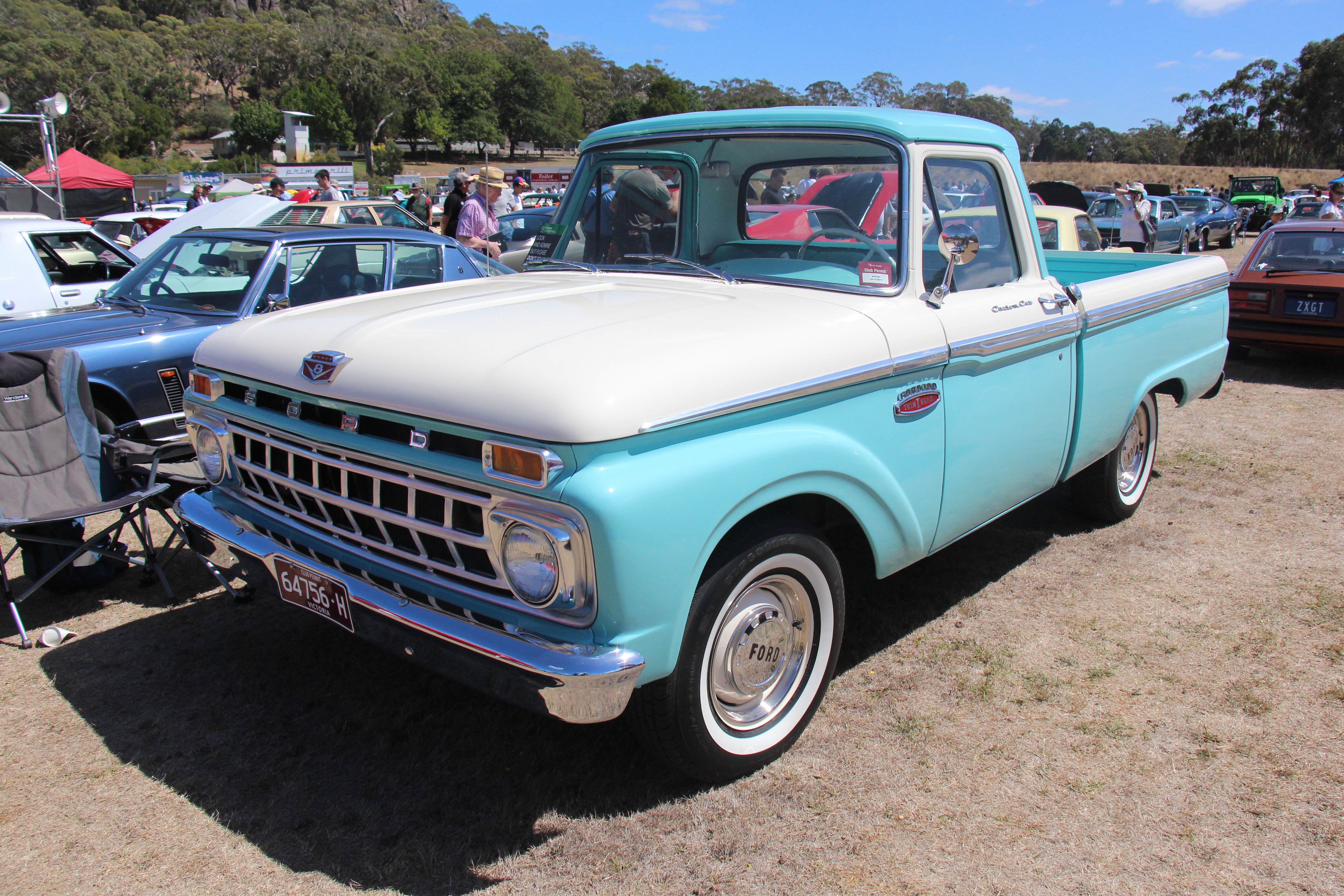
Fourth generation — Twin I-Beam
An experimental unibody design (cab and bed as one welded structure) ran from 1961 to 1963 before being dropped — it twisted under heavy loads.
1965 brought the Twin I-Beam independent front suspension, a real ride-quality leap, alongside the 300 cubic-inch inline-six and the upscale Ranger trim level.
1967–1972
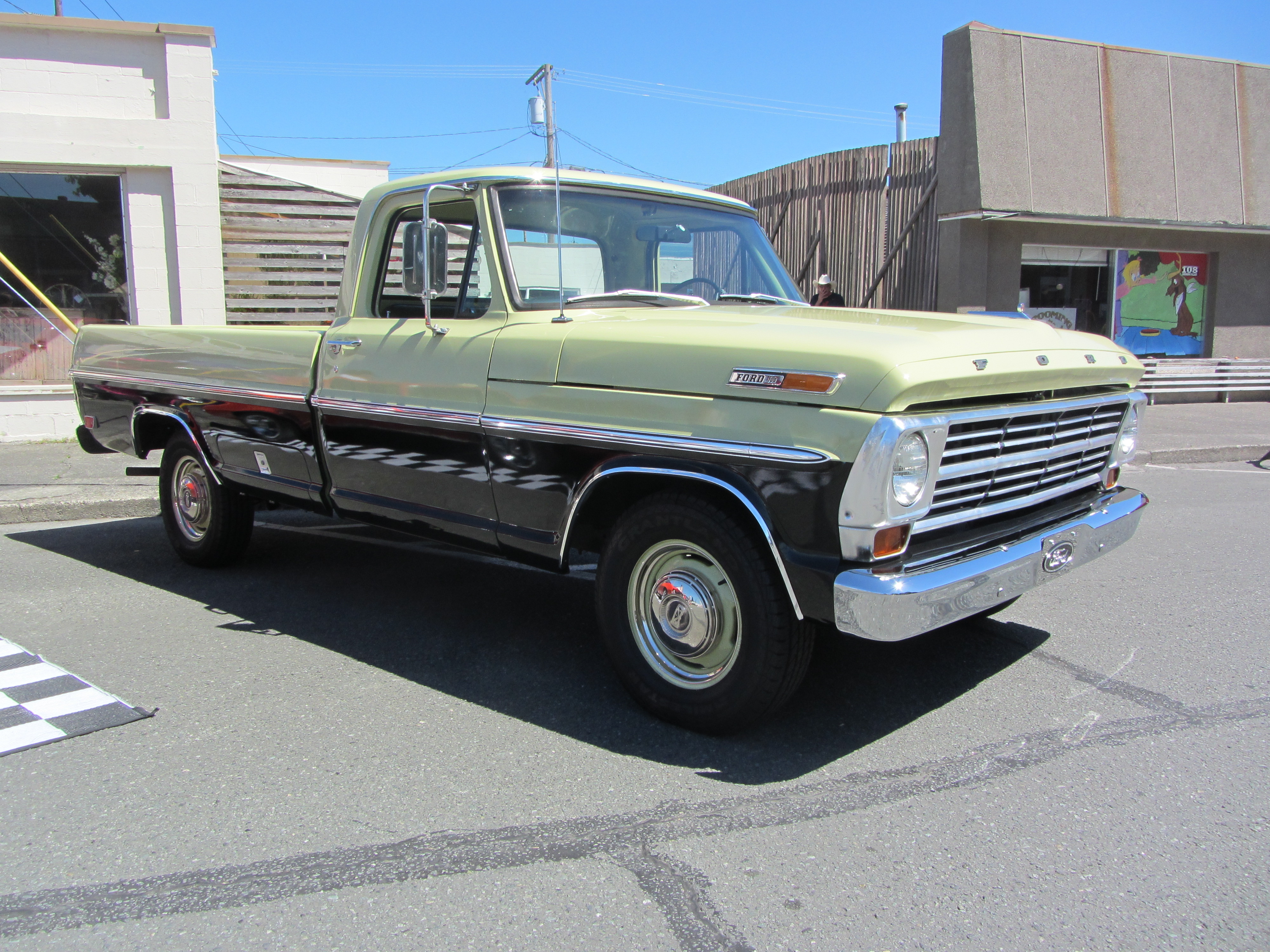
Fifth generation
Sharper body lines, a bigger cabin, and more multi-tone paint and trim options aimed squarely at buyers who wanted a truck that didn't feel like one.
The 302 Windsor V8 joined the lineup in 1969.

1973–1979
Sixth generation — the F-150 arrives
Heavier-duty build quality, double-walled beds, and better corrosion protection defined this generation.
The F-150 was introduced in 1975 to sit between the F-100 and F-250 — a way to keep payload capacity up while dodging stricter emissions rules tied to gross vehicle weight. A 1978 refresh brought the single-piece grille and square headlights most people picture when they hear "square-body Ford."
1980–1986
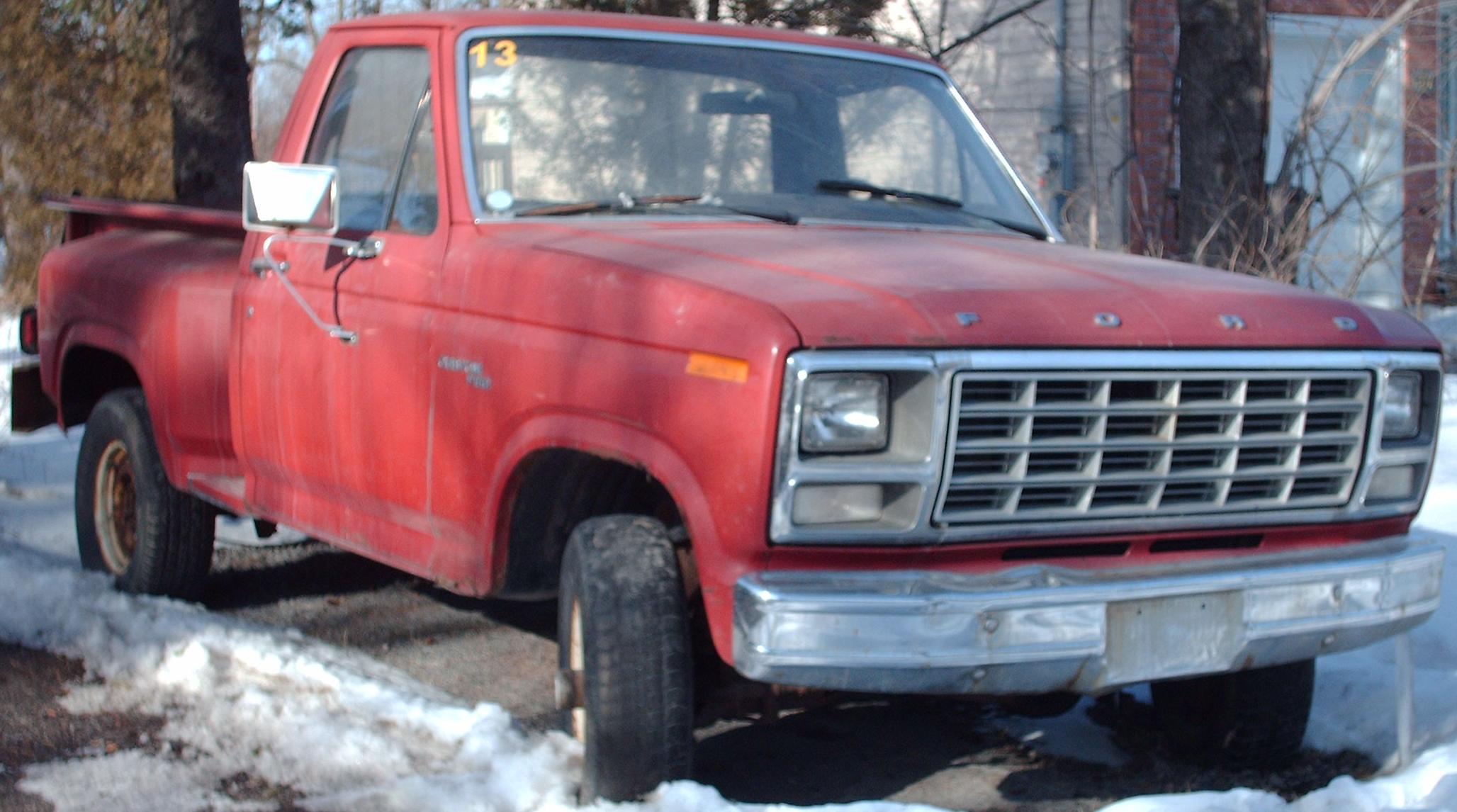
Seventh generation — full redesign
The first clean-sheet chassis and body redesign in over a decade, built around aerodynamics and fuel economy after the fuel crises of the 70s.
The F-100 was dropped after 1983, leaving the F-150 as the definitive half-ton.

1987–1991
Eighth generation — fuel injection era
A deep refresh of the 1980 platform: smoother aero front end, composite headlamps, updated interior.
Carburetors were phased out in favor of multi-port fuel injection across most engines, and rear-wheel ABS arrived as standard equipment.
We work on Fords well past this — through the ninth and tenth generations, right up to the 2008 model year. Ask us about those too.
Chevrolet
Chevrolet's timeline runs parallel to Ford's, and the South African chapter is just as old — Port Elizabeth was assembling right-hand-drive Chevrolets by the mid-1920s, out of necessity as much as ambition.
In South Africa
Chevrolets were being imported into South Africa from 1913. Local assembly began in Port Elizabeth around 1925–26, initially out of a rented wool store, before GM bought land on Kempston Road for a purpose-built plant by 1928 — right-hand drive from day one, since South Africa drives on the left.
Struandale, Port Elizabeth became GM's long-term home for bakkie production, with an engine plant added in 1965.
GM divested from South Africa in 1986–87, restructuring into the locally-owned Delta Motor Corporation as anti-apartheid trade sanctions made continued US ownership untenable. Chevrolet-badged bakkies kept coming off the same Port Elizabeth line for decades afterward — including the later Chevrolet Utility — until GM's final exit from South Africa in 2017, when the operation was sold to Isuzu.

1918–1928
Early years
Chevrolet's first entry into the truck market was the 1918 Model 490 Light Delivery, a car-based chassis that buyers fitted with their own rear bed.
The 1929 "Stovebolt" inline-six set a lasting standard for torque and durability, and factory-built complete pickup beds arrived by the early 1930s.

1947–1955
Advance-Design
GM's first major post-war truck redesign: a wider, more integrated cab, a bold five-bar horizontal grille, and corner cab windows.
This is the look most people picture when they think "classic Chevy truck."

1955–1959
Task Force
Sleeker, more car-like styling with a wrap-around windshield, and the historic debut of the 265 cubic-inch small-block V8 in 1955.
The fiberglass-decked Cameo Carrier arrived the same year, and by 1958 the range added smooth-sided Fleetside beds and quad headlights.

1960–1966
First-generation C/K
The C/K naming convention arrived in 1960 — C for two-wheel drive, K for four — and stuck around for three decades.
Traditional leaf-spring front ends gave way to independent front suspension, torsion bars at first before a switch to coil springs in 1963.
1967–1972
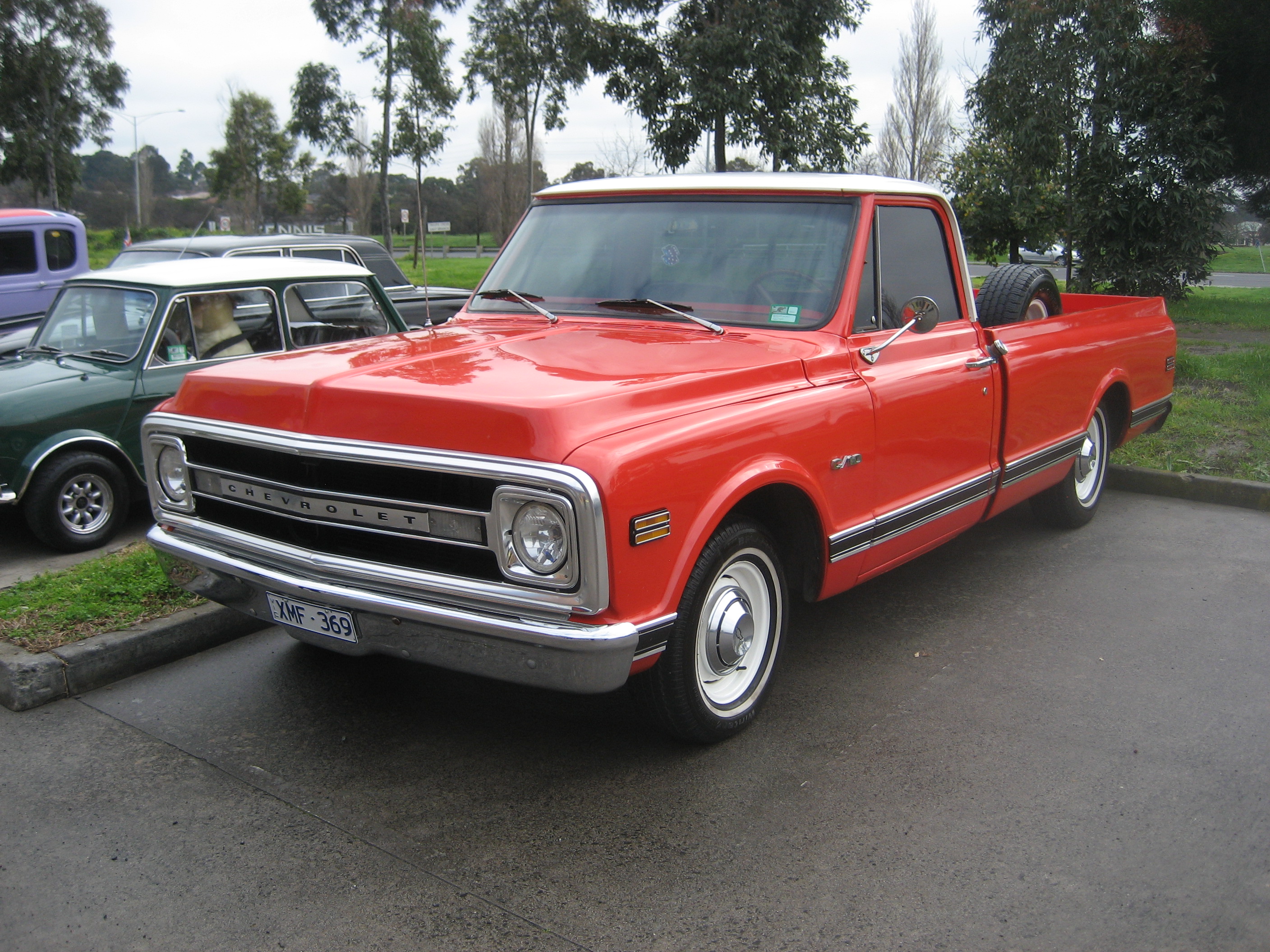
Second-generation C/K — the "Action Line"
Widely regarded as one of the best-looking truck designs GM ever built: aggressive sculpted body lines, a drop-center frame, and the luxury Cheyenne trim.
The K5 Blazer was spun off this platform in 1969.

1973–1987
Third-generation C/K — the "Square Body"
GM's own engineers called it the "Rounded Line" for its wind-tunnel-shaped window frames, but everyone else just calls it the Square Body for its boxy profile.
Known for serious longevity, double-walled beds, and fuel tanks moved outside the frame rails for extra capacity. This generation introduced factory crew cabs, the plush Silverado trim, early Detroit Diesel options, and switched to throttle-body fuel injection by 1987. Heavy-duty and crew-cab versions of this body carried on through 1991 under the R/V designation.

1988–1990+
Fourth-generation C/K — the "OBS"
Launched for 1988, this complete aerodynamic redesign is known today as the OBS — Old Body Style.
Independent front suspension came to all 4x4 models for the first time, interiors modernized, and highway fuel efficiency took a real step forward — groundwork for the 454 SS performance truck that arrived in 1990.
Dodge
Dodge's story is defined by the Power Wagon's brute-force reputation and the Ram's arrival in 1981 — and South Africa's chapter turned out to be better documented than we expected, right down to genuine local production numbers.
In South Africa
Chrysler assembled Valiants at an Elsies River, Cape Town plant before shifting production to Silverton, Pretoria in 1968 — a plant originally built for Chrysler in 1961.
Genuine right-hand-drive Dodge D100, D300, and D500 trucks were sold new here — a surviving 1971 South African sales brochure documents Slant-Six D300 and 318 V8 D500 trims. Local production was small but real: roughly 426 units in 1975, peaking around 506 in 1977, down to 275 by 1979, before local production ended in 1980.
Unlike Ford and GM, Chrysler's South African retreat predates the mid-80s anti-apartheid disinvestment wave. Chrysler SA merged with Illings (the local Mazda importer) in 1976 to form Sigma Motor Corporation amid Chrysler's own global financial crisis, then fully divested its remaining stake by January 1983. Sigma became Amcar in 1984, then merged with Ford SA in 1985 to form Samcor.

1917–1959
Early Dodge and the Power Wagon
Dodge's first truck arrived in 1917, built on a heavy-duty chassis with mechanical components borrowed from Dodge's own passenger cars — Chrysler acquired Dodge in 1928.
The legendary Power Wagon (1945) was derived directly from Dodge's WWII military 4x4s — a factory-built four-wheel-drive workhorse that became globally known for its toughness in agriculture, logging, and construction. Post-war "Pilot-House" cabs (1948–53) gave Dodge trucks unusually high visibility, and by the mid-50s the range picked up early Hemi V8s and smooth-sided "Sweptline" beds.

1961–1980
The D/W series
Dodge unified its truck lineup under the D/W naming system in 1961 — D for two-wheel drive, W for four — with a 100/250/350 weight scale that's still recognizable today.
To fight slipping sales against Ford and Chevy in the late 70s, Dodge leaned hard into custom truck culture with factory lifestyle variants like the hot-rodded Li'l Red Express, the Warlock, and the Macho Power Wagon.

1981–1990
First-generation Ram
For 1981, Dodge officially introduced the first Ram, bringing back the leaping-ram hood ornament last seen in the 1930s.
Squared-off body lines, larger wrap-around taillights, and heavily galvanized sheet metal to fight rust marked this generation, running on the bulletproof Slant-6 and 318/360 small-block V8s. By decade's end, Dodge had added throttle-body fuel injection, rear ABS, and brought back the extended Club Cab.
International Harvester
International Harvester built some genuine firsts — the first factory crew-cab pickup, a Scout that arguably invented the modern SUV — before walking away from the pickup market entirely in 1975.
In South Africa
thin documentationIH's South African footprint is thin compared to the Big Three. Company records confirm a "South African International Harvester Branch" office in Durban, but we haven't found solid evidence of local assembly the way Ford, GM, and even Studebaker had.
Most IH trucks in South Africa today appear to have arrived as private imports rather than factory-new right-hand-drive sales. If you know differently, we'd genuinely like to hear it.
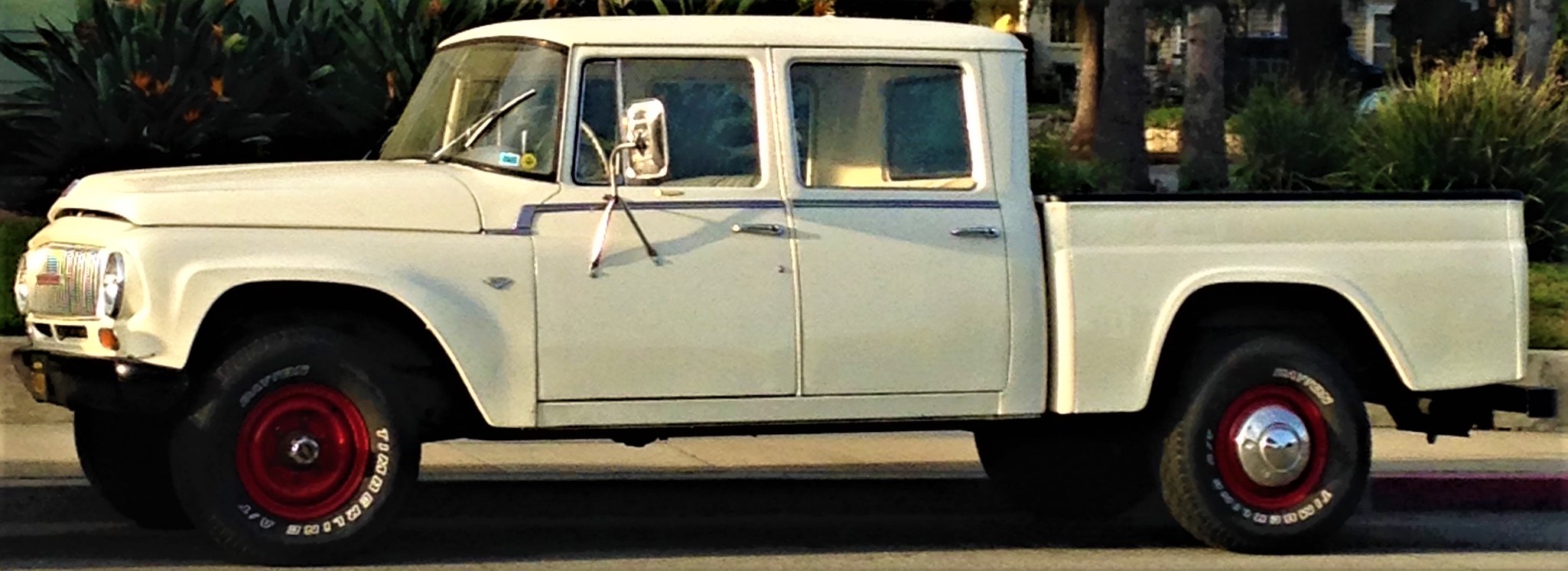
1957–1975
The Travelette — a genuine first
IH built the industry's first factory-production, six-passenger crew-cab pickup — years before Dodge (1963), Ford (1965), or GM (1973) offered one.
It started on the 1957 A/B-series platform, moved to the C/D-series ("Light Line") chassis from 1961, and ran until 1975.

1961–1975
C-series and the Light Line
The C-series ran 1961–1968; the D-series ("Light Line") that replaced it in 1969 was largely a rebodied version with a squared-off look that echoed the contemporary Scout.
By the early 1970s, IH's share of the light-truck market had slipped to around 4%, down from a high point under 10%.

1961–1980
The Scout
Built to compete with the Jeep CJ, the Scout is widely credited as a genuine forerunner of the modern SUV, predating the Ford Bronco and Chevy Blazer.
It evolved from the original Scout 80 through the 800 and 800A, then a full restyle as the Scout II in 1971 — which finally offered V8 power on 2WD models. Production ended in October 1980, driven by a costly six-month UAW strike and a slumping farm-equipment market rather than the pressures that ended the full-size trucks.

1975
Exit from the pickup market
IH's full-size trucks were heavier and less fuel-efficient than their Big Three rivals, and got hit hard by the 1973 OPEC oil embargo.
IH's dealer network stayed commercial-focused rather than adapting to suburban family buyers, and the company chose to redirect its resources toward heavier trucks and the Scout — ending Light Line, Travelall, and Travelette production together in May 1975.
Studebaker
Studebaker's truck line ended earlier than any other brand here — 1964 — but South Africa actually built real Studebakers of its own, at a plant in Uitenhage that later became Volkswagen South Africa.
In South Africa
thin documentationStudebaker had genuine local assembly here through South African Motor Assemblers and Distributors (SAMAD) in Uitenhage — a franchise signed in October 1946, with the first unit off the line in November 1948 and the plant officially opened in February 1949.
SAMAD mostly built passenger cars — the Champion and Commander were the volume sellers — and we haven't found solid sales figures for the pickup lines specifically in the South African market, so treat that part as thin rather than documented.
Volkswagen took a majority stake in SAMAD in 1956, while also starting Beetle production at the same plant. SAMAD stopped assembling Studebakers altogether in 1965 — the compact Lark was the last model built there — and VW bought out the rest in 1966. That operation is Volkswagen of South Africa today.

1937–1949
Coupe Express and the M-series
The stylish, car-based Coupe Express debuted in 1937; Studebaker's first proper truck, the M-series, followed in 1938 and stayed in production through 1949.

1949–1955
2R and 3R series
The M-series was replaced by the 2R, then 3R, series — Studebaker's trucks through the first half of the 1950s.

1955–1958
Transtar
Debuted in 1955 as the E-series, officially renamed Transtar in 1957.
A stripped-down Scotsman variant arrived in 1958, marketed as America's lowest-priced truck.

1960–1964
The Champ — Studebaker's last truck
With a full new cab off the table on cost grounds, Studebaker's engineers took the new Lark compact car's four-door body, cut it in half behind the front doors, and reworked the front end to fit a truck chassis.
Production ended when Studebaker closed its South Bend, Indiana plant in December 1963, cutting the 1964 model year short — just 2,509 Champs were built that final year, down from a peak of over 7,300 in 1962.
After South Bend closed, some final assembly continued briefly through leftover parts kits, including a small run built in Argentina — but by 1966 Studebaker was out of the vehicle business entirely.